
What’s y/Our Story? The ACM at 50
What’s y/Our Story?
Storytelling Workshops: 23 & 24 June.
50th Anniversary, Alliance for Community Media
2026 National Conference, Madison WI
Senate Rooms A & B (1st floor)
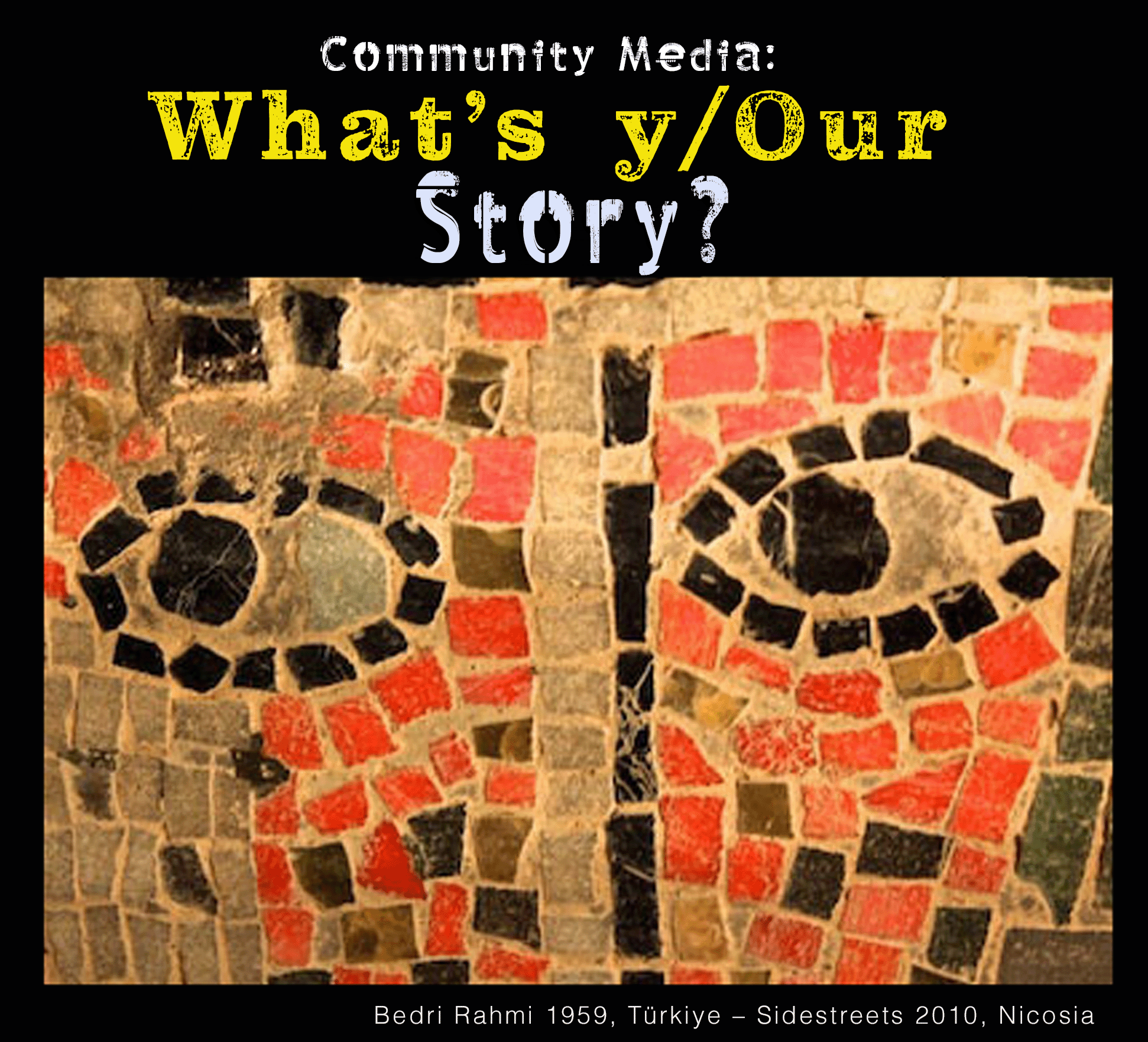
‘What’s Our Story?’
was a community screening of digital stories
at the Cyprus Community Media Centre, December 2010
Attending one of the workshops? Please share some info with John on this Google Form:
https://forms.gle/dkU3AC2DPQU9mnM29
Creating and sharing stories
At the ACM’s 50th anniversary celebration in Madison 2026, we’re nurturing a space and process to create a personal story about a significant/ transformative moment in your experience with community media (Session 1: Creating Stories). Then, we’ll share stories in a community gathering (Session 2: Sharing Stories).
You might (but don’t need to) bring to the workshop an artifact, or 1 – 3 photos that says something to you about your experience with community media. We’ll help you build your story from there.
Materials on this page can also help you create a story if you’re not able to participate in session 1 (Creating Stories). You can then share during session 2 (Sharing Stories). You might also share the story through the ACM’s social media. Feedback is available, too – just ask.
Send to John Higgins: jhiggins [at] MediaProf [dot] org
Between session 1 (Tuesday 6/23) and session 2 (Wednesday 6/24), you can take the time to refine your story. And, if you choose to share with the ACM, SPEAK MPLS will help you record yourself reading/telling your story.
The story “prompt” is usually provided ahead of time, to give time for you to think about story ideas and possible images to use (your own; no AI or internet images).
Workshop Handouts: Creating Story | Story Circle | Reflection Guide
Step 1: Finding Your Story Idea
Use one of these prompts as a starting point for your story idea:
Focus on a moment or time that’s significant to you (an ‘a-ha’ moment or ‘lightning bolt’ moment), when …
- You were first drawn to (‘magnetized’ to) access/ community media;
or - You were struck by the power of access/ community media;
or - You decided to follow a path in access/ community media
–Is there a story that illustrates this significant moment or time?”
-What was that moment or period of time? Tell us about it.
–Then, reflecting on this experience, what was the significance of this moment to you?
-In what way was your life touched by this experience?
A specific moment (or more) probably popped into your mind when you looked over the story prompts. Jot them down! Often the first idea is the story you’re really itching to tell.
Then, write down your story as a script, following the writing and revising guidelines below.
Step 2: Writing and Revising
- Writing Your Story:
- Tell about the experience
- You IN the experience – not apart from it
- What you’ve learned from it / what it meant to you
- Style: Talk to us – tell a story
- Write conversationally – for a story to be heard – not read (even if it’s geared for text/print);
- Practice reading the story out loud. Build in pauses. Read it out loud to yourself. Read it out loud to friends. Try for casual and conversational – not formal.
- If recording, talk to us – so it’s natural and conversational
- Be descriptive
- Smells, sounds, visuals, feelings, etc.
- Use of pauses/silence is good; helps the listener process your story – and fill in mental images
- Aim for 250 words or less.
- It’s helpful if you can revise the script at least 2 times
- After each revision, get feedback, drawing on prompts/questions below (for yourself and to help others with their story);
- Work with 1 or 2 other storytellers. Read aloud your story and get their feedback. Listen to their story and provide them with feedback.
- Follow “story circle guidelines” – and “helpful feedback prompts” below!
- Work with 1 or 2 other storytellers. Read aloud your story and get their feedback. Listen to their story and provide them with feedback.
- After each revision, get feedback, drawing on prompts/questions below (for yourself and to help others with their story);
- If audio/video, less than 3 minutes
- It’s helpful if you can revise the script at least 2 times
- 1-5 personal images, no Internet or AI images
Step 3: Story Circle
What is a Story Circle?
- A group process;
- Emerged during the US Civil Rights Movement by John O’Neal and the Free Southern Theater;
- Adapted to Digital Storytelling by Joe Lambert and the Story Center (formerly the Center for Digital Storytelling)
- A respectful, safe, encouraging, nurturing place to share your thoughts, ideas, emotions – and hear others’;
- Help each other find & develop our stories
- Provide feedback / get feedback
- We are changed as we help others find their stories
- We are changed as we discover the meanings behind our own story
- Build group bond as develop stories;
- Note the process:
- Disciplined
- Speaking in turn, observe time limit
- Respectful, supportive
- “Deep listening”
- Two or three “rounds” of story circle/feedback, each followed by time to revise your story;
- Disciplined
- Help you find your story
- How do you feel about your story
- Your moment of change in the story
- How will people (audience) interpret your story?
Story Circle Agreements
- Focus on the storyteller talking.
- “deep listening.”
- Cell phones or electronic devices – off.
- No “side” conversations.
- Stay in the circle.
- Storyteller reads their story – don’t go off script or ad lib (keeps story focused).
- Storyteller does not respond to comments (write them down)
- Wait your turn to provide a response in the circle.
- It’s ok to pass.
- Talk directly to the storyteller.
- Give a pause (time to reflect) after the storyteller is finished before responding or asking questions.
- Give an appreciative comment first.
- A response might mention something specific you noticed or that stayed with you. Keep it brief: one sentence is enough.
- Preface suggestions with:
- “… if it were my story …” “… you might want to consider …”
- Don’t repeat previous comments
- Ok to agree or see differently than previous comments.
- Ask storyteller if there is anything they would like specific feedback about.
- Tell the storyteller when you can visualize images or situations from the words they have given.
- “When you talked about the staircase to the house, I had an image of steps in a cloud…”
- “The detail that stayed with me was the caller who wouldn’t give their name.”
- “I noticed how you described that moment — you said ‘the whole street showed up.’
- “What struck me was the sense of surprise in your voice.”
Helpful Feedback/ Prompts – for yourself and to others
- Where are you in the story?
- Personally, or emotionally
- What is that actual moment or time period of change that your story is rooted in?
- Why are you telling that story now?
- I felt really engaged with your story when …
- I got a bit lost in your story when …
Share with the ACM
The ACM would like to share your story through social media and other outlets. Your participation is entirely voluntary. Luke, Rebecca, Saniah, and James from SPEAK MPLS will help you record you reading your story between 3:30-4:30 Tuesday (after session 1) and 12:30-1:30 on Wednesday (before session 2) – both in Senate A & B. You can choose to share it with the ACM for possible inclusion on social media.
For feedback or to share your story, contact John Higgins — jhiggins [at] mediaprof [dot] org
Include your name – and give your story a title.
Resources & Story Samples
Resources
- How-To create a digital story: Free preview version of The Digital Storytelling Cookbook, by Joe Lambert and StoryCenter
- The StoryCenter.org: web site
- Digital Storytelling: Urgent Work for Urgent Times, Joe Lambert and Brooke Hessler
- The roots of the Story Circle: John O’Neal, the 1960s Civil Rights Movement, and Free Southern Theater – Junebug.org
- Story Circle facilitation and training: jesikah maria ross
- Story Circles: Deep Listening and Bridge Building on Issues That Matter
- A “How-To Guide” by jesikah for public radio stations who want to collaborate with community organizations to use stories for bridge building and understanding.
- Story Circles: Deep Listening and Bridge Building on Issues That Matter
- Higgins articles:
- Higgins, John. 2011. Peace-building Through Listening, Digital Storytelling, and Community Media in Cyprus. Global Media Journal: Mediterranean Edition 6.1.
- Higgins, John. 2014. Self-reflexivity in Oral Histories: Pedagogical Practices in Cypriot University Classrooms. Chapter in Challenging History: Oral History Work in Cyprus. Ed. Holger Briel. Nicosia: U of Nicosia Press.
- Higgins, John. 1997. Paulo Freire and Social Transformation. Peace Review 9.4: 571-577.
- Additional materials are available on Higgins’ Bio/ Projects/ Articles page.
Story Samples
- Selected examples of digital storytelling from Higgins’ workshops
- Humboldt County
Menlo College, USA: Ben created this story about growing up in Humboldt County, CA. As someone who spends a lot of time with friends in Humboldt, I can state that Ben’s story perfectly reflects the culture. - Spirals
Cyprus. Maria uses this video in her work with at-risk youth in old town Nicosia, to show them you often can accomplish big things if you aren’t aware they can’t be done.
Also, the idea of oldsters moving over to make room for newcomers to the project is a helpful reminder. - Don’t Tell Mama
Cyprus. Short, fun story by Artug. I love the image of him in the red glasses. - The Big Question of My Life
Cyprus. The story prompt was about a significant location/place, or artifact.
Zehra immediately knew the story she just had to tell. I love the video of her grandmother she recorded during the workshop – reacting like so many grandmothers everywhere. - Additional Curated Samples of Digital Storytelling – Higgins’ YouTube StoryFires channel
- Higgins Projects:
- Cyprus Stories: Stories from across the island. University students, middle school students, civil society workshop participants at the Cyprus Community Media Centre.
- MenloTV: Menlo College students
- StoryFires: Univ of San Francisco students
- Higgins’ digital stories: YouTube
- The StoryCenter: YouTube stories
- Humboldt County
- Comic book/ graphic novel storytelling format using Plasq.com’s ComicLife app for mobile, tablet, or laptop:
- Personal self-reflection stories created by students at the University of San Francisco:
- “What Does Authenticity Look Like?” S. Evans
- “Who Am I Today?” I. Sophia
- Additional stories
- Personal self-reflection stories created by students at the University of San Francisco:
MediaProf.org – Storytelling
Includes selected examples of digital storytelling
Attending one of the workshops? Please share some info with John on this Google Form:
https://forms.gle/dkU3AC2DPQU9mnM29